20 resources found

DG Environment
Report

The use of PFAS and fluorine-free alternatives in textiles, upholstry, carpets, leather and apparel

This study, commissioned by DG Environment for the European Commission and produced by Wood and Ramboll.  The objective was to assess the use of PFASs and fluorine-free alternatives in textiles, upholstry, carpets, leather and apparel, including specific focus on volumes of use, technical function, and emissions.

Non-fluorine alternatives considered were hydrocarbons, silicones, dendrimers, polyurethane, nanomaterials, and alternative technologies.  The study makes recommendations for policy, including a REACH restriction on the placing on the market and use of these products that contain any PFAS, and a listing under the Stockholm Convention.  It is also recommended in the report that a restriction could be combined with voluntary industry measures and provisions in public procurement to encourage substitution of PFAS before mandatory legislation is introduced.

EU Chemicals Strategy for Sustainability
Policy document

EU Chemicals Strategy for Sustainability

Chemicals are essential for the well-being, high living standards and comfort of modern society. They are used in many sectors, including health, energy, mobility and housing.

However, most chemicals have hazardous properties which can harm the environment and human health.

The EU already has sophisticated chemicals laws in place, but global chemicals production is expected to double by 2030. The already widespread use of chemicals will also increase, including in consumer products.

The European Commission published a chemicals strategy for sustainability on 14 October 2020. It is part of the EU’s zero pollution ambition, which is a key commitment of the European Green Deal.

Circular_Economy_Electronics_Central_Eastern_Europe
Report

Toward a Circular Economy for the Electronics Sector in Central and Eastern Europe: Overview, Actions and Recommendations

by |
December 2022
copied to clipboard

This report provides an overview of the current status and conditions of the Circular Economy in the electronics value chain in the Central and Eastern Europe (CEE) region, identifies key areas of concern, provides appropriate recommendations, and proposes priority actions to improve circularity of the sector. The recommendations and roadmap focus on the individual life cycle stages of the electronics value chain, as well as on aspects that cut across the value chain. The transition towards a more circular electronics sector in Central and Easter Europe (CEE) would require a holistic and coordinated approach to progress toward a more circular electronics value chain in the CEE region.

This publication was prepared under the framework of the Global Environment Facility (GEF) full-sized project 9771: Global best practices on emerging chemical policy issues of concern under the Strategic Approach to International Chemicals Management (SAICM). This project is funded by the GEF, implemented by UNEP and executed by the SAICM Secretariat.

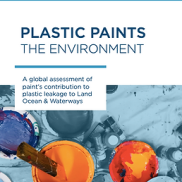
Plastic paints the Environment
Report

Plastic Paints the Environment

February 2022
copied to clipboard

This report provides a global assessment of the level of plastic paint leakage worldwide.

It is based on the baseline year 2019 with a global paint demand of 52 Mt, that included 19.5 Mt of plastics and distributed across different sectors: Architectural, Marine, Road Marking, General Industrial, Automotive and Industrial Wood and Others.

Emerging Policy Issues: Chemicals in products
EIT_RM_PARADE_Hazardous_substances_in_construction_Final_2019
Report

Hazardous Substances in Construction Products and Materials

December 2019
copied to clipboard

This guidance document aims to give an overview of potential hazardous substances that might occur in construction products and when appearing as waste need attention during renovation and demolition activities. Focus in this guideline is on hazardous substances regulated by EU or international agreements or national legislation.

Although the present legislation restricts the use of many hazardous substances in new building products, there is a considerable concern for compounds present in old construction products, since their presence in construction and demolition waste may limit the recyclability of the material and potentially cause waste management problems. One group of substances that has recently received attention are persistent organic pollutants (POP substances) such as e.g. some brominated flame retardants.

Important characteristic of the construction and building products is the relatively long life span. Because of long lifespan the restricted substances will enter the waste stream many decades after a ban has been placed on their use and they can therefore be found in renovation or demolition waste for a long time. Many of these substances provide important functionality in a wide range of products, e.g. flame retardants.

Besides hazardous substances also degradation in composition and quality aspects (e.g. mould) of construction products needs to be considered.

This document is part of the pre-demolition overall guidance document developed in the PARADE project.

Emerging Policy Issues: Chemicals in products
Policy document

Understanding chemicals in products: SAICM Policy Brief

by |
November 2019
copied to clipboard

The transparency of information about chemicals in global supply chains has been an emerging policy issue for the Strategic Approach to International Chemicals Management (SAICM) since 2009, leading to programmes such as the UNEP Chemicals in Products (CiP) Programme. The CiP programme focuses specifically on the textiles, toys, electronics and building materials sectors.Information exchange in the value chain is key in identifying and addressing any chemicals of concern1 in products. Brands and retailers frequently lack crucial knowledge about the properties

SAICM-USEtox_D2.1
Report

List of Chemicals of Concern and of potential alternatives for toys sector, with supporting information on criteria and selection

by |
September 2019
copied to clipboard

In this report, we present a list of Chemicals of Concern (CoCs) in plastic toys, with supporting information on the applied selection criteria. To identify the CoCs, we started from a literature review of available plastic toys compositions studies, and obtained the chemical mass fraction in plastic toy as well as the chemical functions. The chemical emissions from the plastic toys and subsequent human exposures were then estimated using a series of models and the coupled nearfield and far-field exposure assessment framework. Finally, the human exposure doses were compared to toxicity measures such as the reference dose (RfD), or median effective dose (ED50) for cancer effects, to evaluate the health risks on children. Chemical-material combinations that have a hazard quotient (HQ) > 10, a margin of exposure (MoE) < 100, or a lifetime cancer risk > 10-6 were included in the list of CoCs. In total, 35 (less than 10%) of all chemical-material combinations studied were identified as CoCs. The results indicate that a relevant amount of chemicals used in plastic toys may pose a non-negligible health risk to children, calling for more refined investigations and more human- and eco-friendly alternatives.

This document has been developed within the framework of the Global Environment Facility (GEF) project ID: 9771 on Global Best Practices on Emerging Chemical Policy Issues of Concern under the Strategic Approach to International Chemicals Management (SAICM). This project is funded by the GEF, implemented by UNEP and executed by the SAICM Secretariat.

Emerging Policy Issues: Chemicals in products
Policy document

Model Law and Guidance for Regulating Lead Paint

UN Environment, in cooperation with World Health Organization, United States Environment Protection Agency and other partners, has developed a model law and guidance in order to assist countries in establishing and implementing regulation on lead paint.The purpose of this guidance is to assist countries to enact new laws (or to modify their existing laws) to establish a single regulatory limit on the total lead content in paints. The guidance describes the key elements of effective and enforceable legal requirements. It

Emerging Policy Issues: Lead in paint
Topics: Policymaking

Avatar