SAICM Knowledge Management activities are supported by the GEF 9771 project on Global Practices on Emerging Chemical Policy Issues of Concern under the Strategic Approach to International Chemicals Management (SAICM).
Within this framework, the SAICM Secretariat explores ways to create, manage and disseminate knowledge on chemicals of concern. The implementation follows a Knowledge Management Strategy that is being constantly revised and updated. It explores different tools and processes to better manage knowledge cycles, aiming at interlinking knowledge from multiple stakeholders. Communities of practice have been established to support collaborative and innovative exchanges.
My work on training farmers on proper agrochemical use keeps the levels of chemicals in the food chain at minimum residual levels because the farmers are in position to access knowledge on the good agricultural practices that relate to chemical us
My activities envisaged the involvement in a sound management of chemicals at the national level. My professional interests are dedicated to health and environment.
I am currently serving as the Knowledge Management Officer for the GEF-funded the Implementing Sustainable Low and Non-Chemical Development in Small Island Developing States (ISLANDS) Programme which supports Small Islands Developing States (SIDS)
I am the SAICM Programme Officer in charge of the overall management of SAICM GEF funded projects on emerging chemical policy issues. I am also the Knowledge Management Officer who coordinates the development of knowledge and information on chemicals management and responsible for the SAICM knowledge management platform/clearinghouse.My work contributes to ensuring that information is available, accessible, user-friendly, adequate, and appropriate amongst SAICM stakeholders so that policy and decision-makers can take action for the sound management of chemicals towards a healthier environment.I have over twelve years of experience in project management, capacity building, and policy advisory at the United Nations
I am currently supporting the establishment of an online knowledge management system (KMS) for a GEF-funded "Financing Agrochemical Reduction and Management (FARM)" project which aims to tackle the reduction of using highly hazardous pesticides an
Estrategias dinámicas y pluriculturales sobre el recurso humano que este interactuando en el ambiente, para brindar acciones más amenas a la manipulación de los insumos provenientes de la naturaleza o fabricados por el ser humano, a fin de salvagu
Rebecca is an Environmental and Occupational Health Specialist focusing on children’s environmental health, public health, management of hazardous chemicals in products, exposure assessment, chemical risk assessment and management, risk communicat
Have you ever noticed how many chemicals shape people’s daily lives? They keep homes sparkling clean, boost food production, and are included in virtually all manufactured goods surrounding you right now. Chemicals drive the economy but as we produce more than ever before, they have to deliver their benefits without damaging our health and environment.Toxic lead paint for example is still used in many regions of the world and Highly hazardous pesticides continue to poison agricultural workers and contaminate the
The SCP Hotspots Analysis Tool (SCP-HAT) aims at identifying the hot spot areas of unsustainable production and consumption in order to support setting priorities in national SCP and climate policies.
Earth is running out of resources needed for manufacturing materials such as chemicals, minerals, and petroleum. Thus, these components are available only at increasing economic and environmental costs. As an important contribution to a sustainable future, chemistry and its products must be adapted to a circular economy (CE)—a system aimed at eliminating waste, circulating and recycling products, and saving resources and the environment.Nearly 140,000 industrial chemicals are marketed worldwide, and new chemicals are becoming more complex (e.g., stereochemistry, functional groups)
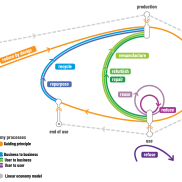
The Building Circularity Platform provides an understanding of the circularity concept, its scope and how it contributes to promoting sustainable consumption and production patterns. It also offers a wide range of resources and features stories illustrating how various stakeholders have successfully adopted circular approaches.