28 resources found

Case studies

Future Policy Award 2021: Sweden, Region Stockholm - Chemicals in products

Although chemicals are important components in many products, they may be released at any stage of the product life cycle, resulting in potential exposures of humans and the environment. The second 2021 Gold Awardee addressing Chemicals in Products is Sweden, Region Stockholm: Phase-Out Lists for Chemicals Hazardous to the Environment and Human Health (2012-2016, revised for 2017-2021).The World Future Council focuses on identifying, developing, highlighting and spreading effective, future-just solutions for current challenges humanity is facing and promote their implementation

Emerging Policy Issues: Chemicals in products
Case studies

Future Policy Award 2021: Sri Lanka - Pesticides

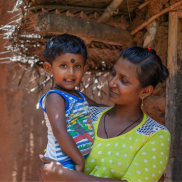
The Special Award Highly Hazardous Pesticides is one of the most ambitious and impactful solutions that minimizes the adverse effects of pesticides, which cause disproportionate harm to the environment and human health. Pesticides can cause severe environmental hazards, high acute, chronic toxicity and are also a very common suicide agent. Particularly, in Sri Lanka, two thirds of suicides were due to self-poisoning with pesticides. The Special Award Highly Hazardous Pesticides was awarded to Sri Lanka’s Control of Pesticides Act No

Case studies

Future Policy Award 2021: Philippines - Lead in Paint

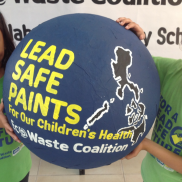
Lead is a cumulative toxic element particularly harmful to young children and pregnant women. Lead can be present at high levels in paint and is a major health concern specially in low and middle income countries. Philippines legislation towards lead-safe paint has provided safer alternatives to protect human health and the environment, actively involving all stakeholders. The Special Award Lead in Paint was awarded to Philippines’ Chemical Control Order for Lead and Lead Compounds (CCO, 2013-24).The World Future Council focuses

Emerging Policy Issues: Lead in paint Chemicals in products
Case studies

Future Policy Award 2021: Kyrgyzstan - Globally Harmonized System of Classification and Labelling of Chemicals

Globally Harmonized System of Classification and Labelling of Chemicals is a non-binding internationally agreed-upon system managed by the UN which defines and classifies the hazards of chemical products. Kyrgyzstan’s Resolution No. 43 on Approval of the Chemical Hazard Classification System and Hazard Information Requirements (2015) has legally bound GHS.The World Future Council focuses on identifying, developing, highlighting and spreading effective, future-just solutions for current challenges humanity is facing and promote their implementation worldwide. The Future Policy Award 2021 highlights exemplary

Emerging Policy Issues: Chemicals in products
Project document

Market Analysis of the Coating Industry in China

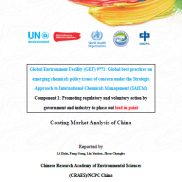
China is a major producer of paints which supplies a considerable share of paints in the world. Key paint production hot spots were identified as Guangdong, Shanghai, Jiangsu, Hunan and Shandong provinces and cities. The cost of removing existing decorative lead paint from surfaces in homes, schools, and other buildings is significant. By comparison, the cost for eliminating the use of lead compounds in new decorative paints is low and alternatives to lead additives are available for all types of
Emerging Policy Issues: Lead in paint
Topics: Policymaking
Project document

Baseline paint market study in Ecuador (English / Spanish)

The World Health Organization (WHO) with the United Nations Environment Program (UNEP) has launched the initiative called "Global Alliance to Eliminate Lead Paint" whose goal is to phase-out the manufacture and sale of paintings that contain lead thereby reducing the exposition to this metal and eliminating its risks and effects on the population.In Ecuador, CEER is the technical executor of the project “Lead-free paints”, carried out with the technical support of the Cleaner Production Centre of Serbia, experts from the
Emerging Policy Issues: Lead in paint
Topics: Policymaking
Project document

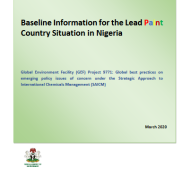
Baseline Information for the Lead Paint Country Situation in Nigeria

Lead in Nigerian paints is another route of lead into the environment and exposure can be caused as a result of inhalation or ingestion especially in children. In 2008, SRADeV Nigeria under the auspices of International Pollutants Elimination Network (IPEN) collected and analyzed decorative paints produced and/or marketed in Nigeria. All the sampled paint brands were found to contain lead higher than 90ppm, in fact up to an alarming level of 129,837ppm in one case. At that time, there were
Emerging Policy Issues: Lead in paint
Topics: Policymaking
Project document

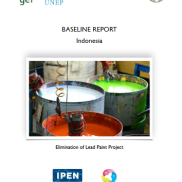
Market Analysis of the paint industry in Indonesia (English / Bahasa)

December 2019
copied to clipboard
Elimination of Lead in Paint in Indonesia - Baseline Information - Indonesia’s paint marketIndonesia holds the first position as the biggest market in paint and coating in South East Asia with the 268 million population and high urbanization rate (57%). Indonesian paint and coating industry growth rate is 6% annually for the past five consecutive years. Paint and coating industry in Indonesia involves six multinational, four domestic, and large numbers of small-scale domestic producers, with the most demand from architectural
Emerging Policy Issues: Lead in paint
Topics: Policymaking

Avatar