37 resources found

Project document

Baseline Information for the Lead Paint Country Situation in Nigeria

Lead in Nigerian paints is another route of lead into the environment and exposure can be caused as a result of inhalation or ingestion especially in children. In 2008, SRADeV Nigeria under the auspices of International Pollutants Elimination Network (IPEN) collected and analyzed decorative paints produced and/or marketed in Nigeria. All the sampled paint brands were found to contain lead higher than 90ppm, in fact up to an alarming level of 129,837ppm in one case. At that time, there were
Emerging Policy Issues: Lead in paint
Topics: Policymaking
Factsheets and brochures

Factsheet of The Quick Start Programme: 13 years of advancing sound chemicals management
by |
January 2020
copied to clipboard
The Quick Start Programme: 13 years of advancing sound chemicals management. Established in 2006 by the first International Conference on Chemicals Management – the Quick Start Programme (QSP) concluded in December 2019. The factsheet shares impact through successful projects and activities across the globe.
Project document

Market Analysis of the paint industry in Indonesia (English / Bahasa)

December 2019
copied to clipboard
Elimination of Lead in Paint in Indonesia - Baseline Information - Indonesia’s paint marketIndonesia holds the first position as the biggest market in paint and coating in South East Asia with the 268 million population and high urbanization rate (57%). Indonesian paint and coating industry growth rate is 6% annually for the past five consecutive years. Paint and coating industry in Indonesia involves six multinational, four domestic, and large numbers of small-scale domestic producers, with the most demand from architectural
Emerging Policy Issues: Lead in paint
Topics: Policymaking
Factsheets and brochures

SAICM Factsheet
by |
November 2019
copied to clipboard
The ChallengeThe Strategic Approach To International Chemicals Management (SAICM) mandate expires in 2020, long before we will reach the target of minimizing the health and environmental impacts of chemicals throughout their lifecycle. Overall progress has been uneven and there is still a significant need for development and implementation of effective chemical and waste management policies and practices around the globe.What We DoSAICM provides a valuable multi-stakeholder forum to discuss and address the many challenges facing the adoption and implemen-tation of
Project document

National Baseline Survey of Paint Market in Peru

United Nations Environment Programme (UNEP) and the World Health Organization (WHO) have established the joint initiative Global Alliance to Eliminate Lead Paint (Lead Paint Alliance) to prevent children’s exposure to lead from paints containing lead and to minimize occupational exposures to lead paints. The broad objective of the Alliance is to promote a phase-out of the manufacture and sale of paints containing lead and eventually eliminate the risks from such paint.CER/Grupo GEA implements the Component 1 “Promoting regulatory and voluntary
Emerging Policy Issues: Lead in paint
Topics: Policymaking
Factsheets and brochures

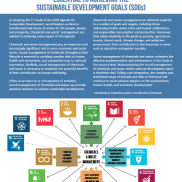
Chemicals and waste management: essential to achieving the Sustainable Development Goals (SDGs)

by |
October 2019
copied to clipboard
In adopting the 17 Goals of the 2030 Agenda for Sustainable Development, world leaders outlined a transformational course of action for the people, planet, and prosperity. Chemicals and waste management are related to achieving every aspect of this Agenda.Chemicals and waste management play an important and increasingly significant role in every economic and social sector. Sound management of chemicals throughout their lifecycle is essential to avoiding complex risks to human health and ecosystems, and substantial costs to national economies. Similarly
Project document

Independent Evaluation of the Strategic Approach to International Chemicals Management from 2006 – 2015

September 2019
copied to clipboard
OBJECTIVESThe objective of the evaluation is to provide an analysis of SAICM activities from 2006-2015 to support the intersessional process of the ICCM to develop recommendations and to enable ICCM5 to take an informed decision on future arrangements for the Strategic Approach and the sound management of chemicals and waste beyond 2020.The evaluation, where appropriate, draws on lessons learned with respect to the implementation of the Strategic Approach, including: • Impact of the Strategic Approach; • Strengths, weaknesses and gaps
Avatar
