104 resources found

Report

Market and Sector Analysis Report of the Chemical Supply Chain of the Construction Sector in Sri Lanka

This market and sector analysis report of the chemical supply chain of the construction sector in Sri Lanka was conducted according to the process outlined in UNEP’s eco-innovation (Eco-i) manual.The construction industry is one of the largest industries in Sri Lanka both in terms of contribution to GDP as well as the labour force involved. As a result, the construction material supply chain is also one of the largest sub sectors in the country. There is an emerging trend in
Emerging Policy Issues: Chemicals in products
Report

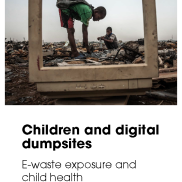
Children and digital dumpsites: e-waste exposure and child health

WHO launched the first comprehensive publication on e-waste, entitled ‘Children and digital dumpsites: e-waste exposure and child health’. The soaring global popularity of electronic and electrical devices, from computers to cell phones to heavy appliances, combined with ineffective waste management and disposal, is triggering a crisis of e-waste health risks to which millions of children, as well as women of childbearing age, are exposed.Informal processing of e-waste through open burning, heating and acid leaching (using cyanide salt, nitric acid or
Database

Lead in paint laboratory database

The Lead in Paint Laboratory Database lists laboratories from all UN regions capable of identifying and quantifying lead in paint samples.It is established by UNEP in close cooperation with the United States Environmental Protection Agency and the World Health Organization as part of an activity of the Global Alliance to Eliminate Lead Paint. For each listed laboratory, the databank offers publicly available information of interest, such as contact details, number of staff, instrumentation, analytical techniques, accreditation, etc. This database of
Emerging Policy Issues: Lead in paint
Report

Chemicals of Concern in the Building and Construction Sector

This UNEP report aims at providing an overview of the challenge that chemicals of concern pose in the context of products relevant for the building and construction sector. It outlines the relevance and linkages of chemicals of concern with regards to a building life cycle and highlights existing gaps, challenges and opportunities regarding the imperative of increasing circularity in the building and construction sector.

Emerging Policy Issues: Chemicals in products
Report

Review of chemicals related Toy Safety Policies and Regulations in selected Low and Middle Income Countries

by |
April 2021
copied to clipboard
With a total revenue of more than 90 billion USD in 2018, the global toy market is an important sector of consumer products. Like many other products, toys are composed of a diverse range of materials. Many of these materials are made of, or contain manufactured chemicals. Most of these chemicals are intentionally added, but some can also be present as unintended contaminants.Many chemicals have properties that can make them hazardous to human health and/or the environment. The potential use
Emerging Policy Issues: Chemicals in products
Report

Commitment platforms and the global agenda for chemicals and waste management
Problem statementOne of functions of the of the Strategic Approach to International Chemicals Management (SAICM) is to call for appropriate action on emerging policy issues as they arise and to forge consensus on priorities for cooperative action as identified in the paragraph 24 of the Overarching Policy Strategy (OPS). In 2015, the Fourth International Conference on Chemicals Management (ICCM-4) initiated the development of the framework for sound management of chemicals and waste beyond 2020 that is envisaged to be adopted
Report

Chemicals of Concern for the Health Sector

Chemicals are widely used in daily life. They have a unique importance in the health-care sector, where they are used as disinfectants, cleaners, laboratory re­agents, sterilants, pesticides, medicines and pharma­ceuticals and in medical devices and equipment. The hazards of these chemicals are not well understood by health professionals nor incorporated into procure­ment decisions.To minimize these hazards, the health sector has been taking steps to promote and implement sustainable healthcare within their institutions and to collaborate externally with suppliers and manufactures
Report

Single-Use Plastic Products (SUPP) and their alternatives: Recommendations from Life Cycle Assessments

UN Environment Programme (UNEP) defines single use plastic products as “an umbrella term for different types of products that are typically used once before being thrown away or recycled” (UNEP 2018), which includes food packaging, bottles, straws, containers, cups, cutlery and shopping bags. It has been estimated that about 100-150 million tonnes of plastics are produced for single use products and about 8 million tonnes of plastics are dumped into the oceans every year (Plastics Oceans 2019)There is a need
Emerging Policy Issues: Chemicals in products
Topics: Life Cycle

Avatar