60 resources found

Database

IOMC Toolbox
IOMC Toolbox for decision making in chemicals management The IOMC Toolbox has been redesigned to provide easier and more direct access to 8 management schemes, 6 toolkits, and more than 500 IOMC tools, guidance documents, and training materials. This new and improved platform enables users to access information with fewer steps and clicks.The IOMC Internet-based Toolbox for Decision Making in Chemicals Management (IOMC Toolbox) is aimed at countries who wish to address specific national issues regarding chemicals management.The IOMC Toolbox
Database

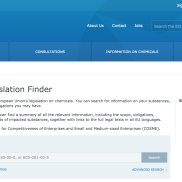
EU Chemicals Legislation Finder

EU Chemicals Legislation Finder (EUCLEF) gives you an overview of the European Union’s legislation on chemicals. You can search for information on your substances, find applicable laws and check what obligations you may have.For each piece of legislation below, you can find a summary of all the relevant information, including the scope, obligations, exemptions, regulatory activities and lists of impacted substances, together with links to the full legal texts in all EU languages.EUCLEF is funded by the EU Programme for
Video

SAICM Emerging Policy Issues Video

Have you ever noticed how many chemicals shape people’s daily lives? They keep homes sparkling clean, boost food production, and are included in virtually all manufactured goods surrounding you right now. Chemicals drive the economy but as we produce more than ever before, they have to deliver their benefits without damaging our health and environment.Toxic lead paint for example is still used in many regions of the world and Highly hazardous pesticides continue to poison agricultural workers and contaminate the
Video

SAICM Perflourinated Chemicals Video

Perflourinated Chemicals (PFCs) are the key ingredient in many stain, water and grease repellent coatings that make outdoor jackets water tight and frying pans non sticky. These chemicals consist of long molecules that contain carbon chains surrounded by fluorine. That bond between carbon and fluorine is incredibly tight. They interact so strongly with each other that the normal, inter-molecular forces, that cause substances to stick to each other, don’t stand a chance.While some types of PFCs are either safe or
Emerging Policy Issues: Perfluorinated Chemicals
Video

SAICM Environmentally Persistent Pharmaceuticals Pollutants Video

Pharmaceuticals are chemicals we specifically design to act on living cells. They regulate, in organisms, hormonal balance and the way it metabolizes its nutrients. Pharmaceuticals even change the way signals travel between cells. In order to work, many drugs have to resist the stomach’s acid environment, so the compounds can reach their destination inside the body. That’s why they are formulated to degrade very slowly or not at all. When active pharmaceuticals pass through our bodies and enter the environment
Emerging Policy Issues: Pharmaceutical pollutants
Video

SAICM Highly Hazardous Pesticides Video

We use a wide variety of chemical compounds to prevent living organisms from damaging crops and spreading diseases like malaria. These compounds are collectively termed pesticides. These days the majority of pesticides have low to moderate acute toxicity. But despite their many positive developments, there remain a small but significant group of Highly Hazardous Pesticides that cause illness and environmental damage.Not only because they are very toxic, but also because they remain active for a long time after being released
Emerging Policy Issues: Highly Hazardous Pesticides
Database

Database of IOMC activities in countries

The database of IOMC activities in countries provides an overview of where individual IOMC organizations are working on chemicals issues in countries.The entries relate to country-specific activities and not normative or general activities applicable to many countries, such as the development of guidelines. Information from the Secretariat of the Basel, Rotterdam and Stockholm Conventions is included as the Secretariat is an observer to the IOMC.
Avatar
