67 resources found

Video

Plastic pollution: harmful chemicals in our plastics

Global cumulative plastic production is predicted to reach 34,000 million tonnes between 1950 and 2050.The harmful chemicals released from plastic products throughout their entire life cycle can pose a serious risk to humans and the environment, including when waste is not properly managed, finding its way to air, water and soils.While the preparations for the legally binding agreement on plastic pollution are ongoing, the plastic waste and chemicals in plastics are being discussed at the 2021/2022 meetings of the conferences

2212521_SAICM_GEF9771_LIP_TechGuide_cover
Manuals and toolkits

Reformulation is Entirely Possible: Summary of the Lead Paint Reformulation Technical Guidelines and How to Use this Information

This document summarizes information from the Lead Paint Reformulation Technical Guidelines, the findings and recommendations of the reformulation pilot demonstrations, and two case studies of paint manufacturers which have reformulated paint products. This summary is also intended to highlight how the information from the Guidelines can be used by different stakeholders involved in the phasing out of lead paint.The full set of technical guidelines can be accessed here.The guidelines were made possible under a global project funded by the Global

Emerging Policy Issues: Lead in paint
Topics: Policymaking
Manuals and toolkits

GREEN Labelling System for Sustainable Building Materials and Products

Sri Lanka, like other countries around the world, is facing an immense challenge, to create sustainable buildings for the future. Buildings are the major source of demand for energy and construction materials which produce a significant amount of by-product greenhouse gases. Studies show that the building sector accounts for over 40 percent of the world’s energy requirements and that a large percentage of the present energy consumption and carbon dioxide generation could be saved by applying certification standards such as
Emerging Policy Issues: Chemicals in products
Manuals and toolkits

GREEN Rating System for New Constructions

by |
February 2022
copied to clipboard
The natural environment together with our economy, health and productivity are immensely affected by the performance of the built environment. According to the Global Status Report 2020, CO2 emissions from the operation of buildings have increased to their highest level yet at around 28% of total global energy-related CO2 emissions. With the inclusion of emissions from the buildings construction industry, this share increases to 38% of total global energy-related CO2 emissions while the total final energy consumption of the global
Emerging Policy Issues: Chemicals in products
Manuals and toolkits

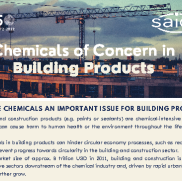
Chemicals of Concern in the Building and Construction Sector - Summary

by |
September 2021
copied to clipboard

This is the summary of the UNEP report on Chemicals of Concern in the Building and Construction Sector.The report aims at providing an overview of the challenge that chemicals of concern pose in the context of products relevant for the building and construction sector. It outlines the relevance and linkages of chemicals of concern with regards to a building life cycle and highlights existing gaps, challenges and opportunities regarding the imperative of increasing circularity in the building and construction sector.The

Emerging Policy Issues: Chemicals in products
Video

Gender equality to make mercury history

On International Women’s Day, the Secretariat of the Minamata Convention on Mercury launched a video on how women are more negatively impacted by mercury and what needs to be done to better protect, support and promote gender equality. watch the videoThe Minamata Convention tackles mercury throughout its entire life cycle, fighting gender issues every step of the way. This includes supporting gender-specific trainings and helping implement National Action Plans with a gender perspective -- with special focus on the problem
Emerging Policy Issues: Endocrine-Disrupting Chemicals
Video

ICCM5 Joint video message UNEP ED and German Minister for the Environment

Joint video message from Svenja Schulze, German Minister for the Environment, and Inger Andersen, Executive Director of the United Nations Environment Programme, on the Fifth session of the International Conference on Chemicals Management (ICCM5) that should have started this week in Bonn, and has been postponed because of the COVID-19 pandemic. Both call upon the international community to keep the momentum going to protect human health and the environment from the potential adverse impacts of chemicals and waste beyond 2020
Video

SAICM Secretariat Team

December 2020
copied to clipboard
SAICM Secretariat Team
Avatar
