62 resources found

Policy document

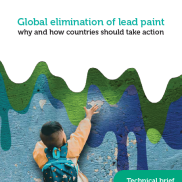
Global elimination of lead paint: why and how countries should take action - Policy brief

Lead has toxic effects on almost all body systems and is especially harmful for children and pregnant women. Lead paint is an avoidable source of exposure to lead. “Lead paint” or “lead-based paint” is paint to which one or more lead compounds have been intentionally added by the manufacturer to obtain specific characteristics. One important way to prevent exposure is for countries to establish legally binding regulatory measures prohibiting the addition of lead to paint.This policy brief summarizes key information
Emerging Policy Issues: Lead in paint
Policy document

Global elimination of lead paint: why and how countries should take action - Technical brief

This document has been developed for officials in government who have a role in regulating lead paint, to provide them with concise technical information on the rationale and steps required to phase out lead paint. “Lead paint” or “lead-based paint” is paint to which one or more lead compounds have been intentionally added by the manufacturer to obtain specific characteristics. This document explains the health and economic importance of preventing lead exposure by establishing legally binding controls to stop the
Emerging Policy Issues: Lead in paint
Policy document

Plastics and Chemicals of Concern In Consumer Products

by |
July 2020
copied to clipboard
Plastics are used across the economy and in diverse downstream sectors such as packaging, construction, transportation, healthcare, textiles, and electronics. Durable products, ranging from construction materials to medical devices make up nearly half of the global plastics market, while packaging products are the largest uses of single-use plastics. Some plastics contain chemicals that are considered to be harmful for health and the environment. Phthalates, poly-fluorinated chemicals, bisphenol A (BPA), brominated flame retardants and antimony trioxide are considered most harmful for
Emerging Policy Issues: Chemicals in products
Topics: Circularity
Policy document

New digital technologies to tackle trade in illegal pesticides

Global trade in illegal pesticides has been steadily growing in recent years, posing serious threats to agriculture, the environment, human health, and the economy. Evidence of this trend can be found in the increasing number of seizures of counterfeit, fake, and unauthorised pesticides, as well as their growing share in the global pesticide market. This paper identifies the main drivers and enablers of this illicit trade, and explores the potential of digital technologies, such as blockchain, to support policies to
Video

SAICM Emerging Policy Issues Video

Have you ever noticed how many chemicals shape people’s daily lives? They keep homes sparkling clean, boost food production, and are included in virtually all manufactured goods surrounding you right now. Chemicals drive the economy but as we produce more than ever before, they have to deliver their benefits without damaging our health and environment.Toxic lead paint for example is still used in many regions of the world and Highly hazardous pesticides continue to poison agricultural workers and contaminate the
Video

SAICM Perflourinated Chemicals Video

Perflourinated Chemicals (PFCs) are the key ingredient in many stain, water and grease repellent coatings that make outdoor jackets water tight and frying pans non sticky. These chemicals consist of long molecules that contain carbon chains surrounded by fluorine. That bond between carbon and fluorine is incredibly tight. They interact so strongly with each other that the normal, inter-molecular forces, that cause substances to stick to each other, don’t stand a chance.While some types of PFCs are either safe or
Emerging Policy Issues: Perfluorinated Chemicals
Video

SAICM Environmentally Persistent Pharmaceuticals Pollutants Video

Pharmaceuticals are chemicals we specifically design to act on living cells. They regulate, in organisms, hormonal balance and the way it metabolizes its nutrients. Pharmaceuticals even change the way signals travel between cells. In order to work, many drugs have to resist the stomach’s acid environment, so the compounds can reach their destination inside the body. That’s why they are formulated to degrade very slowly or not at all. When active pharmaceuticals pass through our bodies and enter the environment
Emerging Policy Issues: Pharmaceutical pollutants
Video

SAICM Highly Hazardous Pesticides Video

We use a wide variety of chemical compounds to prevent living organisms from damaging crops and spreading diseases like malaria. These compounds are collectively termed pesticides. These days the majority of pesticides have low to moderate acute toxicity. But despite their many positive developments, there remain a small but significant group of Highly Hazardous Pesticides that cause illness and environmental damage.Not only because they are very toxic, but also because they remain active for a long time after being released
Emerging Policy Issues: Highly Hazardous Pesticides

Avatar