76 resources found

Database

IOMC Toolbox
IOMC Toolbox for decision making in chemicals management The IOMC Toolbox has been redesigned to provide easier and more direct access to 8 management schemes, 6 toolkits, and more than 500 IOMC tools, guidance documents, and training materials. This new and improved platform enables users to access information with fewer steps and clicks.The IOMC Internet-based Toolbox for Decision Making in Chemicals Management (IOMC Toolbox) is aimed at countries who wish to address specific national issues regarding chemicals management.The IOMC Toolbox
Database

EU Chemicals Legislation Finder

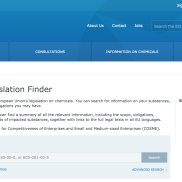
EU Chemicals Legislation Finder (EUCLEF) gives you an overview of the European Union’s legislation on chemicals. You can search for information on your substances, find applicable laws and check what obligations you may have.For each piece of legislation below, you can find a summary of all the relevant information, including the scope, obligations, exemptions, regulatory activities and lists of impacted substances, together with links to the full legal texts in all EU languages.EUCLEF is funded by the EU Programme for
Database

Database of IOMC activities in countries

The database of IOMC activities in countries provides an overview of where individual IOMC organizations are working on chemicals issues in countries.The entries relate to country-specific activities and not normative or general activities applicable to many countries, such as the development of guidelines. Information from the Secretariat of the Basel, Rotterdam and Stockholm Conventions is included as the Secretariat is an observer to the IOMC.
Policy document

Challenges for a Sustainable Chemicals and Materials Policy: The Need for Transformation in the Global Context

by |
December 2019
copied to clipboard
Over the past few years the use of natural resources and the production of chemicals have increased dramatically – and a further increase is forecast. Whereas earlier the main focus was on local effects on health and the environment, in the meantime it has become clear that current ways of dealing with natural resources, chemicals and products manufactured from chemicals are threatening the biosphere as a whole.In 2009 and 2015 scientists introduced the concept of planetary boundaries. As part of
Policy document

Knowledge Management and Information Sharing for the Sound Management of Industrial Chemicals

«Knowledge and Information» is one of the five Strategic Objectives of SAICM.SAICM’s Overarching Policy Strategy recognizes that knowledge, information and public awareness are the foundations of sound decision-making, on the management of chemicals and products containing chemicals. However, the Policy Strategy also under-lines that there is a lack of clear, timely and appro-priate information easily accessible to local popula-tions about the health and safety effects of chemi-cals.It is for this reason, that knowledge and information sharing are critical components of
Policy document

Revised Guidance Document 150 on Standardised Test Guidelines for Evaluating Chemicals for Endocrine Disruption

by |
September 2018
copied to clipboard
The OECD releases the Revised Guidance Document 150 on Standardised Test Guidelines for Evaluating Chemicals for Endocrine Disruption originally published in 2012 and updated in 2018 to reflect new and updated OECD test guidelines, as well as reflect on scientific advances in the use of test methods and assessment of the endocrine activity of chemicals. The document is intended to provide guidance for evaluating chemical using standardised test guidelines. Specific objectives include providing a description of the OECD conceptual framework
Emerging Policy Issues: Endocrine-Disrupting Chemicals
Policy document

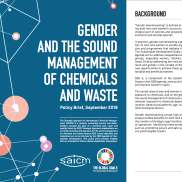
Gender and the sound management of chemicals and waste

by |
September 2018
copied to clipboard
“Gender mainstreaming” is defined as a strategy for making both men and women’s concerns and experiences an integral part of policies and programmes in all political, economic and societal spheres.In practice, gender mainstreaming supports the contribution of men and women to society equally, through policies and programmes that address their specific needs. The Sustainable Development Goals (SDGs) of the 2030 Agenda aim to address inequalities among all population groups, especially women, children, and the impoverished. Directly addressing the links between
Emerging Policy Issues: Chemicals in products
Policy document

Gender and the sound management of chemicals and waste: Prepared for the SAICM intersessional process beyond 2020

A request was made at the first intersessional meeting for information on the relationship between women and chemical safety as it relates to emerging policy issues and issues of concern, covering in particular the period beyond 2020. The Bureau agreed at its May 2017 meeting for the secretariat to prepare a paper, for the second intersessional meeting, that reviews the broader concept of gender and the sound management of chemicals and waste, in line with the 2030 Agenda for Sustainable
Avatar