77 resources found

Academic article

Antimicrobial pharmaceuticals in the aquatic environment - occurrence and environmental implications

by
ScienceDirect
|
November 2019
copied to clipboard
The environmental occurrence of antimicrobial pharmaceuticals and antibiotic resistant bacteria and antibiotic resistant genes has become a global phenomenon and a multifaceted threat. Integrated actions of many parties are needed to prevent further aggravation of the problem. Well-directed actions require clear understanding of the problem, which can be ensured by frequent revaluation of the existing knowledge and disseminating it among relevant audiences. The goal of this review paper is to discuss the occurrence and abundance of antimicrobial pharmaceuticals in the
Emerging Policy Issues: Pharmaceutical pollutants
Policy document

Knowledge Management and Information Sharing for the Sound Management of Industrial Chemicals

«Knowledge and Information» is one of the five Strategic Objectives of SAICM.SAICM’s Overarching Policy Strategy recognizes that knowledge, information and public awareness are the foundations of sound decision-making, on the management of chemicals and products containing chemicals. However, the Policy Strategy also under-lines that there is a lack of clear, timely and appro-priate information easily accessible to local popula-tions about the health and safety effects of chemi-cals.It is for this reason, that knowledge and information sharing are critical components of
Policy document

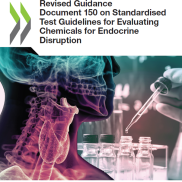
Revised Guidance Document 150 on Standardised Test Guidelines for Evaluating Chemicals for Endocrine Disruption

by |
September 2018
copied to clipboard
The OECD releases the Revised Guidance Document 150 on Standardised Test Guidelines for Evaluating Chemicals for Endocrine Disruption originally published in 2012 and updated in 2018 to reflect new and updated OECD test guidelines, as well as reflect on scientific advances in the use of test methods and assessment of the endocrine activity of chemicals. The document is intended to provide guidance for evaluating chemical using standardised test guidelines. Specific objectives include providing a description of the OECD conceptual framework
Emerging Policy Issues: Endocrine-Disrupting Chemicals
Policy document

Gender and the sound management of chemicals and waste

by |
September 2018
copied to clipboard
“Gender mainstreaming” is defined as a strategy for making both men and women’s concerns and experiences an integral part of policies and programmes in all political, economic and societal spheres.In practice, gender mainstreaming supports the contribution of men and women to society equally, through policies and programmes that address their specific needs. The Sustainable Development Goals (SDGs) of the 2030 Agenda aim to address inequalities among all population groups, especially women, children, and the impoverished. Directly addressing the links between
Emerging Policy Issues: Chemicals in products
Academic article

Nanomaterials in the environment: Behavior, fate, bioavailability, and effects—An updated review

by
Wiley Online Library
|
April 2018
copied to clipboard
The present review covers developments in studies of nanomaterials (NMs) in the environment since our much cited review in 2008. We discuss novel insights into fate and behavior, metrology, transformations, bioavailability, toxicity mechanisms, and environmental impacts, with a focus on terrestrial and aquatic systems. Overall, the findings were that: 1) despite substantial developments, critical gaps remain, in large part due to the lack of analytical, modeling, and field capabilities, and also due to the breadth and complexity of the area
Emerging Policy Issues: Nanotechnology
Policy document

Gender and the sound management of chemicals and waste: Prepared for the SAICM intersessional process beyond 2020
A request was made at the first intersessional meeting for information on the relationship between women and chemical safety as it relates to emerging policy issues and issues of concern, covering in particular the period beyond 2020. The Bureau agreed at its May 2017 meeting for the secretariat to prepare a paper, for the second intersessional meeting, that reviews the broader concept of gender and the sound management of chemicals and waste, in line with the 2030 Agenda for Sustainable
Policy document

SAICM texts and resolutions of the International Conference on Chemicals Management

September 2015
copied to clipboard
The new version of SAICM texts exists in English only and includes the resolutions adopted by ICCM at its first, second and third sessions. The older other language versions include only resolutions adopted by ICCM at its first session.New activities included in the Global Plan of ActionAt ICCM3 (17-21 September 2012), SAICM stakeholders agreed to the inclusion of new activities relating to the environmentally sound management of nanotechnologies and manufactured nanomaterials and hazardous substances within the life-cycle of electrical and
Policy document

Overall Orientation and Guidance for achieving the 2020 goal of sound management of chemicals

The future we want for the sound management of chemicals1.In paragraph 23 of the Johannesburg Plan of Implementation, adopted at the World Summit on Sustainable Development in 2002, Governments identified the goal of “achiev[ing] by 2020, that chemicals are used and produced in ways that lead to the minimization of significant adverse effects on human health and the environment” (see appendixA).That goal was further adopted as part of the Strategic Approach to International Chemicals Management by the International Conference on
Avatar