47 resources found

Project document

Baseline Information for the Lead Paint Country Situation in Nigeria

Lead in Nigerian paints is another route of lead into the environment and exposure can be caused as a result of inhalation or ingestion especially in children. In 2008, SRADeV Nigeria under the auspices of International Pollutants Elimination Network (IPEN) collected and analyzed decorative paints produced and/or marketed in Nigeria. All the sampled paint brands were found to contain lead higher than 90ppm, in fact up to an alarming level of 129,837ppm in one case. At that time, there were
Emerging Policy Issues: Lead in paint
Topics: Policymaking
Project document

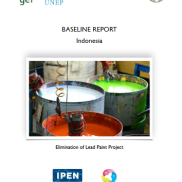
Market Analysis of the paint industry in Indonesia (English / Bahasa)

December 2019
copied to clipboard
Elimination of Lead in Paint in Indonesia - Baseline Information - Indonesia’s paint marketIndonesia holds the first position as the biggest market in paint and coating in South East Asia with the 268 million population and high urbanization rate (57%). Indonesian paint and coating industry growth rate is 6% annually for the past five consecutive years. Paint and coating industry in Indonesia involves six multinational, four domestic, and large numbers of small-scale domestic producers, with the most demand from architectural
Emerging Policy Issues: Lead in paint
Topics: Policymaking
Policy document

Challenges for a Sustainable Chemicals and Materials Policy: The Need for Transformation in the Global Context

by |
December 2019
copied to clipboard
Over the past few years the use of natural resources and the production of chemicals have increased dramatically – and a further increase is forecast. Whereas earlier the main focus was on local effects on health and the environment, in the meantime it has become clear that current ways of dealing with natural resources, chemicals and products manufactured from chemicals are threatening the biosphere as a whole.In 2009 and 2015 scientists introduced the concept of planetary boundaries. As part of
Project document

National Baseline Survey of Paint Market in Peru

United Nations Environment Programme (UNEP) and the World Health Organization (WHO) have established the joint initiative Global Alliance to Eliminate Lead Paint (Lead Paint Alliance) to prevent children’s exposure to lead from paints containing lead and to minimize occupational exposures to lead paints. The broad objective of the Alliance is to promote a phase-out of the manufacture and sale of paints containing lead and eventually eliminate the risks from such paint.CER/Grupo GEA implements the Component 1 “Promoting regulatory and voluntary
Emerging Policy Issues: Lead in paint
Topics: Policymaking
Project document

Independent Evaluation of the Strategic Approach to International Chemicals Management from 2006 – 2015

September 2019
copied to clipboard
OBJECTIVESThe objective of the evaluation is to provide an analysis of SAICM activities from 2006-2015 to support the intersessional process of the ICCM to develop recommendations and to enable ICCM5 to take an informed decision on future arrangements for the Strategic Approach and the sound management of chemicals and waste beyond 2020.The evaluation, where appropriate, draws on lessons learned with respect to the implementation of the Strategic Approach, including: • Impact of the Strategic Approach; • Strengths, weaknesses and gaps
Project document

National baseline information on lead paint in Jordan

September 2019
copied to clipboard
The World Health Organization (WHO) with the United Nations Environment Program (UNEP) has launched the initiative called "Global Alliance to Eliminate Lead Paint" whose goal is to phase-out the manufacture and sale of paintings that contain lead thereby reducing the exposition to this metal and eliminating its risks and effects on the population.In Jordan there are 77 factories for the production of paints, there are laws and standard to regulate the paint manufacturing in Jordan and to reduce the use
Emerging Policy Issues: Lead in paint
Topics: Policymaking
Policy document

Knowledge Management and Information Sharing for the Sound Management of Industrial Chemicals

«Knowledge and Information» is one of the five Strategic Objectives of SAICM.SAICM’s Overarching Policy Strategy recognizes that knowledge, information and public awareness are the foundations of sound decision-making, on the management of chemicals and products containing chemicals. However, the Policy Strategy also under-lines that there is a lack of clear, timely and appro-priate information easily accessible to local popula-tions about the health and safety effects of chemi-cals.It is for this reason, that knowledge and information sharing are critical components of
Policy document

Revised Guidance Document 150 on Standardised Test Guidelines for Evaluating Chemicals for Endocrine Disruption

by |
September 2018
copied to clipboard
The OECD releases the Revised Guidance Document 150 on Standardised Test Guidelines for Evaluating Chemicals for Endocrine Disruption originally published in 2012 and updated in 2018 to reflect new and updated OECD test guidelines, as well as reflect on scientific advances in the use of test methods and assessment of the endocrine activity of chemicals. The document is intended to provide guidance for evaluating chemical using standardised test guidelines. Specific objectives include providing a description of the OECD conceptual framework
Emerging Policy Issues: Endocrine-Disrupting Chemicals

Avatar