129 resources found

Report

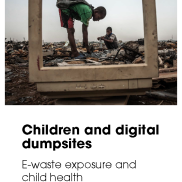
Children and digital dumpsites: e-waste exposure and child health

WHO launched the first comprehensive publication on e-waste, entitled ‘Children and digital dumpsites: e-waste exposure and child health’. The soaring global popularity of electronic and electrical devices, from computers to cell phones to heavy appliances, combined with ineffective waste management and disposal, is triggering a crisis of e-waste health risks to which millions of children, as well as women of childbearing age, are exposed.Informal processing of e-waste through open burning, heating and acid leaching (using cyanide salt, nitric acid or
Website

International Waters Learning Exchange and Resource Network (IW Learn)

by
GEF
|
June 2021
copied to clipboard
IW:LEARN is the Global Environment Facility's (GEF) International Waters Learning Exchange and Resource Network. The IW:LEARN project was established to strengthen transboundary water management around the globe by collecting and sharing best practices, lessons learned, and innovative solutions to common problems across the GEF International Waters portfolio. It promotes learning among project managers, country official, implementing agencies, and other partners.
Community of practice summary of discussions

Reformulation is entirely possible

The Secretariat of the Strategic Approach to Chemicals Management (SAICM) and the University of Cape Town (UCT) have established a Community of Practice (CoP) on Lead in Paint to bring representatives from different sectors together and to create a learning network around issues related to the elimination of Lead Paint. This is a summary of the discussion on Reformulation is entirely possible, which took place on 9 June 2021.Presenters: Dr Branko Dunjic (NCPC Serbia), Vojislavka Satric (NCPC Serbia), Jeiel Guarino
Emerging Policy Issues: Lead in paint
Community of practice summary of discussions

Promoting youth engagement with different stakeholders in chemicals and waste
The Secretariat of the Strategic Approach to Chemicals Management (SAICM) and the University of Cape Town (UCT) have launched a Community of Practice (CoP) on Chemicals and SDGs to bring representatives from different sectors together and to create a learning network around issues related to addressing Chemicals and the Sustainable Development Goals (SDGs). This is a summary of the discussion on Promoting youth engagement with different stakeholders in chemicals and waste, which took place on 26 May 2021.Presenters: Dickson Ho
Database

Lead in paint laboratory database

The Lead in Paint Laboratory Database lists laboratories from all UN regions capable of identifying and quantifying lead in paint samples.It is established by UNEP in close cooperation with the United States Environmental Protection Agency and the World Health Organization as part of an activity of the Global Alliance to Eliminate Lead Paint. For each listed laboratory, the databank offers publicly available information of interest, such as contact details, number of staff, instrumentation, analytical techniques, accreditation, etc. This database of
Emerging Policy Issues: Lead in paint
Community of practice summary of discussions

The Role of Alternatives in Phasing out HHPs

The SAICM Secretariat, in partnership with the University of Cape Town, established a community of practice on Highly Hazardous Pesticides (HHPs) to foster discussions, exchange of best practices, and recommendations to address HHPs amongst relevant stakeholders. This is a summary of the discussion on The Role of Alternatives in Phasing out HHPs, which took place on 19 May 2021.Presenters: Francesca Mancini (FAO), Mark Davis (CPSP), Alex Stuart (PAN UK), Sheila Willis (PAN UK)There may often be a perception that HHPs
Emerging Policy Issues: Highly Hazardous Pesticides
Community of practice summary of discussions

Community of Practice on Lead in Paint - 2020 Digest Compliation

The Secretariat of the Strategic Approach to Chemicals Management (SAICM) and the University of Cape Town (UCT) have established a Community of Practice (CoP) on Lead in Paint to bring representatives from different sectors together and to create a learning network around issues related to the elimination of Lead Paint. This is a compilation of summaries of the discussions, which took place in 2020.
Emerging Policy Issues: Lead in paint
Avatar