38 resources found

Factsheets and brochures

Addressing Chemicals of Concern in Electrical and Electronic Equipment - Options for Action for Policymakers

by |
December 2021
copied to clipboard
The global production and consumption of Electrical and Electronic Equipment (EEE) is growing rapidly and EEE has become indispensable in modern societies, enhancing living standards. Currently, the total weight of global EEE consumption (excluding photovoltaic panels) on average increases by 2.5 million metric tons annually. This increasing consumption and production leads to an increase in raw material extraction and accompanying pollution.The options for action proposed in this document are intended to inspire policymakers and to offer guidance on possible entry
Emerging Policy Issues: Chemicals in products
Report

Towards a Circular Economy for the Electronics Sector in Africa: Overview, Actions and Recommendations

by |
December 2021
copied to clipboard

This report provides an overview of the current state of circularity in the electronics value chain in Africa, identifies key areas of concern, provides appropriate recommendations, and proposes priority actions to improve circularity of the sector.The recommendations focus on the individual life cycle stages of the electronics value chain, as well as on aspects that cut across the value chain. The transition towards a more circular electronics sector in Africa would require a holistic, coordinated approach bridging five key areas

Report

A Chemicals Perspective on Designing with Sustainable Plastics: Goals, Considerations and Trade-offs

by |
December 2021
copied to clipboard
The development of plastic products does not systematically take sustainability, particularly from a chemicals perspective, into account. This report seeks to enable the creation of inherently sustainable plastic products by integrating sustainable chemistry thinking in the design process. By applying a chemicals lens during the plastic material selection process, designers and engineers can make informed decisions to incorporate sustainable plastic during the conceptualisation phase of their products. The report provides an integrated approach to sustainable plastic selection from a chemicals
Emerging Policy Issues: Chemicals in products
Topics: Life Cycle
Factsheets and brochures

Using a value chain approach to reduce chemicals of concern

by |
October 2021
copied to clipboard
Chemicals of concern (CoCs) contained in everyday products can have harmful impacts on human health and the environment. While chemical-related impacts can often occur during a product’s use or end-of-life, decisions influencing product ingredients are taken further upstream of the value chain. Action to address CoCs in products thus need to consider the entire value chain and impactful interventions need to be made at upstream stages to protect human health and the environment from chemical pollution. UNEP is working on
Report

Regional Electronics Study and Circularity Roadmap in the LAC Region: Mapping of Existing Initiatives

Technological development has made electrical and electronic equipment (EEE1) essential parts of contemporary life and indispensable products in today’s societies. Information technology (IT) combined with the technological advances in recent decades, has resulted in EEE having a great influence on the daily life of consumers in aspects such as health, safety, knowledge, comfort information, among others. The global consumption of electronics is growing 2.5 million metric tons per year (Forti, Baldé, Kuehr, & Bel, 2020), because technology increases the living

Report

Mapping of Stakeholders for the Regional Electronics Study and Circularity Roadmap in the Latin America and The Caribbean

This document has been developed within the framework of the Global Environment Facility (GEF) project ID: 9771 on Global Best Practices on Emerging Chemical Policy Issues of Concern under the Strategic Approach to International Chemicals Management (SAICM). This project is funded by the GEF, implemented by UNEP and executed by the SAICM Secretariat.Under the project, UNEP is partnering with Universidad El Bosque to develop a Regional Electronics Study and Circularity Roadmap in the Latin America and the Caribbean (LAC) Region

Report

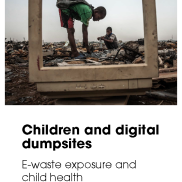
Children and digital dumpsites: e-waste exposure and child health

WHO launched the first comprehensive publication on e-waste, entitled ‘Children and digital dumpsites: e-waste exposure and child health’. The soaring global popularity of electronic and electrical devices, from computers to cell phones to heavy appliances, combined with ineffective waste management and disposal, is triggering a crisis of e-waste health risks to which millions of children, as well as women of childbearing age, are exposed.Informal processing of e-waste through open burning, heating and acid leaching (using cyanide salt, nitric acid or
Report

Single-Use Plastic Products (SUPP) and their alternatives: Recommendations from Life Cycle Assessments

UN Environment Programme (UNEP) defines single use plastic products as “an umbrella term for different types of products that are typically used once before being thrown away or recycled” (UNEP 2018), which includes food packaging, bottles, straws, containers, cups, cutlery and shopping bags. It has been estimated that about 100-150 million tonnes of plastics are produced for single use products and about 8 million tonnes of plastics are dumped into the oceans every year (Plastics Oceans 2019)There is a need
Emerging Policy Issues: Chemicals in products
Topics: Life Cycle

Avatar