148 resources found

pharos-hbn
Database

Pharos

December 2022
copied to clipboard

Pharos provides resources to assess human and environmental health hazards of chemicals and building materials, plus tools to collaborate to find safer alternatives. The goal of this effort is to reduce the use of hazardous chemicals and improve the inherent safety of materials and products.

Pharos provides hazard, use, and exposure information on 178,411 chemicals and 220 different kinds of building products.

Hazard Assessments

Certified GreenScreen assessments in the public domain or for sale.

Hazard Lists

Authoritative scientific lists for health and environmental hazards and restricted substance lists.

Common Products

Common contents and hazards of 220 different kinds of building products.

Data Services

Pharos data in bulk and expert analysis from HBN researchers.

Emerging Policy Issues: Chemicals in products
SAICMUCT CDSG CoP Discussion 4 2022 digest
Community of practice summary of discussions

Environmental Injustice Issues to Consider for Chemical Risk

by |
November 2022
copied to clipboard

The Secretariat of the Strategic Approach to Chemicals Management (SAICM) and the University of Cape Town (UCT) have launched a Community of Practice (CoP) on Chemicals and SDGs to bring representatives from different sectors together and to create a learning network around issues related to addressing Chemicals and the Sustainable Development Goals (SDGs). This is a summary of the discussion on Environmental Injustice Issues to Consider for Chemical Risk, which took place on 23 November 2022.

Presenters: Rico Euripidou (groundWork)

SAICMUCT CDSG CoP Discussion 3 2022 digest
Community of practice summary of discussions

Plastic pollution: ideas for addressing chemicals in plastics
by |
October 2022
copied to clipboard

The Secretariat of the Strategic Approach to Chemicals Management (SAICM) and the University of Cape Town (UCT) have launched a Community of Practice (CoP) on Chemicals and SDGs to bring representatives from different sectors together and to create a learning network around issues related to addressing Chemicals and the Sustainable Development Goals (SDGs). This is a summary of the discussion on Plastic pollution: ideas for addressing chemicals in plastics, which took place on 19 October 2022.

Presenters: Brenda Koekkoek (UNEP), Jost Dittkrist (UNEP), Dr. Eeva Leinala (OECD), Mochamad Adi Septiono (Nexus3 Foundation)

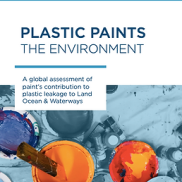
Plastic paints the Environment
Report

Plastic Paints the Environment

February 2022
copied to clipboard

This report provides a global assessment of the level of plastic paint leakage worldwide.

It is based on the baseline year 2019 with a global paint demand of 52 Mt, that included 19.5 Mt of plastics and distributed across different sectors: Architectural, Marine, Road Marking, General Industrial, Automotive and Industrial Wood and Others.

Emerging Policy Issues: Chemicals in products
HML-Cabinetry-Spectrum-Dec3
Manuals and toolkits

Healthier Cabinetry Guide

December 2021
copied to clipboard

At face value, cabinetry may seem to be made of one type of wood, but its construction is much more complex. Many prefabricated cabinets are built using a combination of three or more wood composites and veneers, which typically use toxic glues containing formaldehyde, a known human carcinogen.

By comparing the material contents and construction in prefabricated cabinets, we created a spectrum that indicates the relationship between affordability and health. We typically consider the health effects during all phases of product development, but these diagrams are focused on the health effects during installation and inhabitation.

Currently, prefabricated cabinets are composed of 5%-30% healthier materials. Designers can increase this percentage by requesting manufacturers to build with NAF (no added formaldehyde) composite woods. This often comes with an increased price. Our Composite Wood Product and Spec Guidance gives a range of healthier substitutions.

Emerging Policy Issues: Chemicals in products
Policy document

A review of PFAS as a Chemical Class in the Textiles Sector - Policy Brief

For over a decade, under both SAICM and the Stockholm Convention on Persistent Organic Pollutants (POPs), the class of chemicals known as PFAS is gaining increasing international attention. Since 2009, chemicals in products have been identified as an Emerging Policy Issue and PFAS as an Issue of Concern by the SAICM. The textiles sector is currently considered in the SAICM context through the ‘Chemicals in Products Programme’, which focuses on four priority sectors: textiles, toys, building products and electronics. The
EIT_RM_PARADE_Hazardous_substances_in_construction_Final_2019
Report

Hazardous Substances in Construction Products and Materials

December 2019
copied to clipboard

This guidance document aims to give an overview of potential hazardous substances that might occur in construction products and when appearing as waste need attention during renovation and demolition activities. Focus in this guideline is on hazardous substances regulated by EU or international agreements or national legislation.

Although the present legislation restricts the use of many hazardous substances in new building products, there is a considerable concern for compounds present in old construction products, since their presence in construction and demolition waste may limit the recyclability of the material and potentially cause waste management problems. One group of substances that has recently received attention are persistent organic pollutants (POP substances) such as e.g. some brominated flame retardants.

Important characteristic of the construction and building products is the relatively long life span. Because of long lifespan the restricted substances will enter the waste stream many decades after a ban has been placed on their use and they can therefore be found in renovation or demolition waste for a long time. Many of these substances provide important functionality in a wide range of products, e.g. flame retardants.

Besides hazardous substances also degradation in composition and quality aspects (e.g. mould) of construction products needs to be considered.

This document is part of the pre-demolition overall guidance document developed in the PARADE project.

Emerging Policy Issues: Chemicals in products
Avatar