32 resources found

Policy document

Plastics and Chemicals of Concern In Consumer Products

by |
July 2020
copied to clipboard
Plastics are used across the economy and in diverse downstream sectors such as packaging, construction, transportation, healthcare, textiles, and electronics. Durable products, ranging from construction materials to medical devices make up nearly half of the global plastics market, while packaging products are the largest uses of single-use plastics. Some plastics contain chemicals that are considered to be harmful for health and the environment. Phthalates, poly-fluorinated chemicals, bisphenol A (BPA), brominated flame retardants and antimony trioxide are considered most harmful for
Emerging Policy Issues: Chemicals in products
Topics: Circularity
Manuals and toolkits

Guidance to Provide Footprint Information on Sustainable Alternatives

As there is an increase in communication of concrete recommendations for better solutions and alternatives to build a better economy that protects nature, there is an increased need to back these recommendations with facts and figures about how they contribute to reduce our impact on the planet.In this sense, the life cycle team has pulled together a very simple 2-page guidance on elements to consider when backing up your recommendations with strong life-cycle based science. The 2-pager also provides links
Emerging Policy Issues: Chemicals in products
Topics: Life Cycle
E-learning

Introduction to Life Cycle Thinking

This is one of the Life Cycle Initiative E-learning modules, with courses in English, French, Arabic and Spanish. This E-Learning Module Kit draws on materials from the Life Cycle Initiative and it is aimed at helping give all participants an overview of life cycle approaches while developing understanding as to how to assess the impacts of any given sustainability issue considering all of its life cycle stages. The module is also intended as a guide to which kind of LCT

Emerging Policy Issues: Chemicals in products
Topics: Life Cycle
Academic article

Rethinking chemistry for a circular economy

by
ScienceDirect
|
January 2020
copied to clipboard
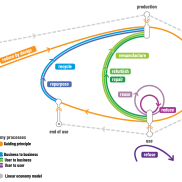
Earth is running out of resources needed for manufacturing materials such as chemicals, minerals, and petroleum. Thus, these components are available only at increasing economic and environmental costs. As an important contribution to a sustainable future, chemistry and its products must be adapted to a circular economy (CE)—a system aimed at eliminating waste, circulating and recycling products, and saving resources and the environment.Nearly 140,000 industrial chemicals are marketed worldwide, and new chemicals are becoming more complex (e.g., stereochemistry, functional groups)
Emerging Policy Issues: Chemicals in products

Website

Building Circularity Platform

The Building Circularity Platform provides an understanding of the circularity concept, its scope and how it contributes to promoting sustainable consumption and production patterns. It also offers a wide range of resources and features stories illustrating how various stakeholders have successfully adopted circular approaches.
Emerging Policy Issues: Chemicals in products
Report

Global Waste Management Outlook

Better waste management offers great potential to help us meet the sustainability challenges ahead. Targeting decision-makers and many other inter-connected sectors, the Global Waste Management Outlook (GWMO) was launched at the World Congress of The International Solid Waste Association (ISWA) in Belgium on 7 September, 2015 . The publication also contains two summary documents, making the information concise and accessible.Developed by UNEP in collaboration with ISWA in response to the UNEP Governing Council request of February 2013, its goal was
Avatar