41 resources found

Community of practice summary of discussions

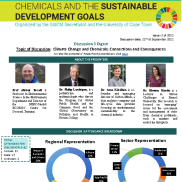
Climate Change and Chemicals: Connections and Consequences
September 2021
copied to clipboard
The Secretariat of the Strategic Approach to Chemicals Management (SAICM) and the University of Cape Town (UCT) have launched a Community of Practice (CoP) on Chemicals and SDGs to bring representatives from different sectors together and to create a learning network around issues related to addressing Chemicals and the Sustainable Development Goals (SDGs). This is a summary of the discussion on Climate Change and Chemicals: Connections and Consequences, which took place on 22 September 2021.Presenters: Prof. Alistair Boxall (ECORISC CDT)
Community of practice summary of discussions

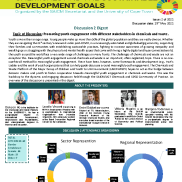
Promoting youth engagement with different stakeholders in chemicals and waste

The Secretariat of the Strategic Approach to Chemicals Management (SAICM) and the University of Cape Town (UCT) have launched a Community of Practice (CoP) on Chemicals and SDGs to bring representatives from different sectors together and to create a learning network around issues related to addressing Chemicals and the Sustainable Development Goals (SDGs). This is a summary of the discussion on Promoting youth engagement with different stakeholders in chemicals and waste, which took place on 26 May 2021.Presenters: Dickson Ho
Policy document

Engaging the textiles industry as a key sector in SAICM: a review of PFAS as a chemical class in the textile sector

by
Natural Resources Defense Council (NRDC)
|
May 2021
copied to clipboard
The report examines the class approach for PFAS as it applies to the textile sector, which covers a wide variety of consumer products and connects two important issues covered in the SAICM context. The textile sector is an appropriate choice given the environmental significance of the sector and the scope of PFAS used within it. Both the quantity of PFAS in use and the variety of uses make this sector a priority for action. Furthermore, the nature of the sector—with
Emerging Policy Issues: Chemicals in products
Community of practice summary of discussions

Community of Practice on Chemicals and SDGs - 2020 Digest Compliation
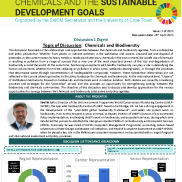
The Secretariat of the Strategic Approach to Chemicals Management (SAICM) and the University of Cape Town (UCT) have launched a Community of Practice (CoP) on Chemicals and SDGs to bring representatives from different sectors together and to create a learning network around issues related to addressing Chemicals and the Sustainable Development Goals (SDGs). This is a compilation of summaries of the discussions, which took place in 2020.
Community of practice summary of discussions

Chemicals and Biodiversity
The Secretariat of the Strategic Approach to Chemicals Management (SAICM) and the University of Cape Town (UCT) have launched a Community of Practice (CoP) on Chemicals and SDGs to bring representatives from different sectors together and to create a learning network around issues related to addressing Chemicals and the Sustainable Development Goals (SDGs). This is a summary of the discussion on Chemicals and Biodiversity, which took place on 28 April 2021.Presenter: Neville Ash (UNEP-WCMC)This discussion focused on the relationships and
Report

Commitment platforms and the global agenda for chemicals and waste management
by |
April 2021
copied to clipboard
Problem statementOne of functions of the of the Strategic Approach to International Chemicals Management (SAICM) is to call for appropriate action on emerging policy issues as they arise and to forge consensus on priorities for cooperative action as identified in the paragraph 24 of the Overarching Policy Strategy (OPS). In 2015, the Fourth International Conference on Chemicals Management (ICCM-4) initiated the development of the framework for sound management of chemicals and waste beyond 2020 that is envisaged to be adopted
Report

Chemicals of Concern for the Health Sector

Chemicals are widely used in daily life. They have a unique importance in the health-care sector, where they are used as disinfectants, cleaners, laboratory re­agents, sterilants, pesticides, medicines and pharma­ceuticals and in medical devices and equipment. The hazards of these chemicals are not well understood by health professionals nor incorporated into procure­ment decisions.To minimize these hazards, the health sector has been taking steps to promote and implement sustainable healthcare within their institutions and to collaborate externally with suppliers and manufactures
Factsheets and brochures

Case studies on the implementation of the WHO Chemicals Road Map

The World Health Organization is publishing a series of national case studies on the implementation of the WHO Chemicals Road map, which was adopted in World Health Assembly Decision 70(23).The case studies were developed by different Member States, including members of the Global Chemicals and Health Network. They illustrate the role the health sector plays in the sound management of chemicals, recognizing the need for multi-sectoral cooperation at a national level.The case studies concentrate on different actions of the road
Avatar
