38 resources found

Report

Mapping of Stakeholders for the Regional Electronics Study and Circularity Roadmap in the Latin America and The Caribbean

This document has been developed within the framework of the Global Environment Facility (GEF) project ID: 9771 on Global Best Practices on Emerging Chemical Policy Issues of Concern under the Strategic Approach to International Chemicals Management (SAICM). This project is funded by the GEF, implemented by UNEP and executed by the SAICM Secretariat.Under the project, UNEP is partnering with Universidad El Bosque to develop a Regional Electronics Study and Circularity Roadmap in the Latin America and the Caribbean (LAC) Region

Video

Gender equality to make mercury history

On International Women’s Day, the Secretariat of the Minamata Convention on Mercury launched a video on how women are more negatively impacted by mercury and what needs to be done to better protect, support and promote gender equality. watch the videoThe Minamata Convention tackles mercury throughout its entire life cycle, fighting gender issues every step of the way. This includes supporting gender-specific trainings and helping implement National Action Plans with a gender perspective -- with special focus on the problem
Emerging Policy Issues: Endocrine-Disrupting Chemicals
Report

Women, Chemicals and the SDGs

by
IPEN , SAICM ,
|
December 2020
copied to clipboard
Gender Review Mapping with a Focus on Women and Chemicals: Impact of Emerging Policy Issues and the Relevance for the Sustainable Development GoalsThe aim of this report is to show the impact chemicals have on women as a vulnerable group highly exposed to hazardous chemicals and gender inequalities re­lated to decision-making around the management of chemicals and waste. The report also means to provide concrete steps that can be taken to safeguard the health of women and empower women in
Report

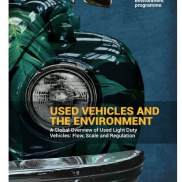
Used Vehicles and the Environment

by |
October 2020
copied to clipboard
Used Vehicles and the Environment - A Global Overview of Used Light Duty Vehicles: Flow, Scale and RegulationMillions of used cars, vans and minibuses exported from Europe, the USA and Japan to low- and middle-income countries are hindering efforts to combat climate change. They are contributing to air pollution and are often involved in road accidents. Many of them are of poor quality and would fail road-worthiness tests in the exporting countries.A landmark, first-of-its-kind United Nations Environment Programme (UNEP) report
Emerging Policy Issues: Chemicals in products
Topics: Circularity
Factsheets and brochures

Gender mainstreaming in chemicals and waste policies

by
HEJSupport International
|
August 2020
copied to clipboard
New Fact Sheet: Gender mainstreaming in chemicals and waste policiesGender equality is a core human rights and development issue, as highlighted in several international and regional human rights instruments, including those that are part of multilateral environmental agreements. Law-binding and voluntary agreements on chemicals and waste are no exception and play an essential role in increasing the participation of women and men in the management of chemicals and waste, while contributing to gender equality.The fact sheet includes examples of texts
Community of practice summary of discussions

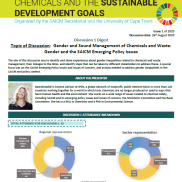
Gender and sound management of chemicals and waste: Gender and the SAICM Emerging Policy Issues

The Secretariat of the Strategic Approach to Chemicals Management (SAICM) and the University of Cape Town (UCT) have launched a Community of Practice (CoP) on Chemicals and SDGs to bring representatives from different sectors together and to create a learning network around issues related to addressing Chemicals and the Sustainable Development Goals (SDGs). This is a summary of the discussion on Gender and sound management of chemicals and waste: Gender and the SAICM Emerging Policy Issues, which took place on
Policy document

Plastics and Chemicals of Concern In Consumer Products

by |
July 2020
copied to clipboard
Plastics are used across the economy and in diverse downstream sectors such as packaging, construction, transportation, healthcare, textiles, and electronics. Durable products, ranging from construction materials to medical devices make up nearly half of the global plastics market, while packaging products are the largest uses of single-use plastics. Some plastics contain chemicals that are considered to be harmful for health and the environment. Phthalates, poly-fluorinated chemicals, bisphenol A (BPA), brominated flame retardants and antimony trioxide are considered most harmful for
Emerging Policy Issues: Chemicals in products
Topics: Circularity
Academic article

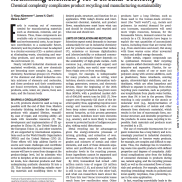
Rethinking chemistry for a circular economy

by
ScienceDirect
|
January 2020
copied to clipboard
Earth is running out of resources needed for manufacturing materials such as chemicals, minerals, and petroleum. Thus, these components are available only at increasing economic and environmental costs. As an important contribution to a sustainable future, chemistry and its products must be adapted to a circular economy (CE)—a system aimed at eliminating waste, circulating and recycling products, and saving resources and the environment.Nearly 140,000 industrial chemicals are marketed worldwide, and new chemicals are becoming more complex (e.g., stereochemistry, functional groups)
Emerging Policy Issues: Chemicals in products
Avatar