7 resources found

cover
Factsheets and brochures

Addressing Chemicals of Concern: Key messages and lessons learned

by |
February 2024
copied to clipboard

This document summarises lessons learned from the various project activities in three sectors: electrical and electronic equipment (EEE); building and construction; and toys. It also formulates key messages addressed to different stakeholder groups and provides links to guidance and tools developed under the GEF project

Factsheets and brochures

UNEP tools to address lead in paint

by |
October 2023
copied to clipboard

Factsheet with UNEP tools to address lead in paint

Emerging Policy Issues: Lead in paint
Factsheets and brochures

Potential Alternatives to PFASs in Carpets and Rugs

Safer Consumer Products (SCP) has compiled a list of alternatives to PFASs in carpets and rugs to assist manufacturers looking for substitutes. The alternatives have been grouped into two categories: non-chemical and chemical alternatives. Products and manufacturers are listed but they are not endorsed by SCP and the safety of the alternatives has not been assessed.

Emerging Policy Issues: Perfluorinated Chemicals
Hinkley employees dismantling a laptop
Factsheets and brochures

Initiating Circularity for electronic waste in Nigeria: A promising paradigm for treating e-waste globally

Over half a million tonnes of discarded electronic appliances are improperly processed in Nigeria every year, threatening the country's environment and the health of approximately 100,000 informal workers in the recycling industry.
With support from the Global Environment Facility (GEF), the Government of Nigeria has joined forces with the United Nations Environment Programme (UNEP) and partners to turn the tide on e-waste under the “Circular Economy Approaches for the Electronics Sector in Nigeria” project. Led by UNEP and supported by the National Environmental Standards and Regulations Enforcement Agency of Nigeria (NESREA), the $15-million initiative brought together players from the Government, the private sector, and civil society to design and operationalise a financially self-sustaining circular economy (CE) for electronics in Nigeria.
The project aims to stimulate a CE pilot through an Extended Producer Responsibility (EPR) scheme that serves as a model for countries facing similar challenges. EPR is an integrated waste management approach that extends the responsibility of manufacturers to the entire lifecycle of their product, particularly to the end-of-life treatment. By applying this approach, the producers will be obliged to commission for collecting, pre-treating and recycling their originated e-waste. 
The project creates synergies among pre-existing elements of an EPR system in Nigeria to establish a sustainable management system and financing mechanism for EPR implementation. Establishing and enforcing a sustainable approach in Nigeria with supporting regulations and legally binding requirements is expected to recover and re-introduce usable materials into the value chain, dispose of hazardous e-waste streams in an environmentally sound manner, and create safe employment for Nigerian e-waste workers.


building-code-fact-sheet-19-01-23
Factsheets and brochures

Building Insulation Code Change Fact Sheet

In January 2019, the California Building Standards Commission unanimously approved changes to the state building codes proposed by the California Office of the State Fire Marshal. The changes allow use of polystyrene insulation without flame retardants below a concrete slab-on-grade. These changes would maintain fire safety while improving human and environmental health.  This fact sheet details the key considerations for implementation of a policy on allowing flame retardant-free insulation within a building code, and the associated health and technical considerations.

Emerging Policy Issues: Chemicals in products
Project document

Baseline paint market study in Ecuador (English / Spanish)

The World Health Organization (WHO) with the United Nations Environment Program (UNEP) has launched the initiative called "Global Alliance to Eliminate Lead Paint" whose goal is to phase-out the manufacture and sale of paintings that contain lead thereby reducing the exposition to this metal and eliminating its risks and effects on the population.In Ecuador, CEER is the technical executor of the project “Lead-free paints”, carried out with the technical support of the Cleaner Production Centre of Serbia, experts from the
Emerging Policy Issues: Lead in paint
Topics: Policymaking
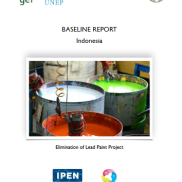
Project document

Market Analysis of the paint industry in Indonesia (English / Bahasa)

December 2019
copied to clipboard
Elimination of Lead in Paint in Indonesia - Baseline Information - Indonesia’s paint marketIndonesia holds the first position as the biggest market in paint and coating in South East Asia with the 268 million population and high urbanization rate (57%). Indonesian paint and coating industry growth rate is 6% annually for the past five consecutive years. Paint and coating industry in Indonesia involves six multinational, four domestic, and large numbers of small-scale domestic producers, with the most demand from architectural
Emerging Policy Issues: Lead in paint
Topics: Policymaking

Avatar