24 resources found

Report

Sustainable Chemicals and Materials Policy for Protecting the Climate and Biodiversity

by |
April 2022
copied to clipboard
Chemicals and materials policy deals with both the risks and the opportunities of chemicals as well as with the volume of material flows from raw material extraction to waste. As with the policy areas of climate and biodiversity, there is a need for a global transformation in chemicals and materials policy with a strong focus on the guiding principles of precaution and sustainability. The boundaries of our planet must no longer be exceeded.The impacts of chemicals and materials are closely
Emerging Policy Issues: Chemicals in products
Report

Fluorochemicals: Persistent, Dangerous, Avoidable

by |
December 2021
copied to clipboard
PFAS are non-aromatic, organic chemicals in which the hydrogen atoms in the carbon chain are fully replaced (“per”) or partly but almost entirely replaced (“poly”) by fluorine atoms. At least 4,700 substances belong to this group of substances. All these chemicals have in common that their environmental degradability is fairly slow and very limited and therefore remain resistant for years to decades.PFAS are “forever chemicals.” Even when being incinerated for disposal, very high temperatures are required for these compounds to
Emerging Policy Issues: Chemicals in products
Community of practice summary of discussions

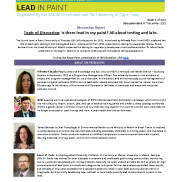
Is there lead in my paint? All about testing and labs

December 2021
copied to clipboard

The Secretariat of the Strategic Approach to Chemicals Management (SAICM) and the University of Cape Town (UCT) have established a Community of Practice (CoP) on Lead in Paint to bring representatives from different sectors together and to create a learning network around issues related to the elimination of Lead Paint. This is a summary of the discussion on Is there lead in my paint? All about testing and labs, which took place on 8 December 2021.Presenters: Mihaela Claudia Paun (UNEP)

Emerging Policy Issues: Lead in paint
Report

Report of the 2020 International Lead poisoning Prevention Week

The eighth International Lead Poisoning Prevention Week (ILPPW) was held on 25–31 October 2020, with more than 90 events in 60 countries organized by governments, civil society organizations, health partners, industry and other institutions.ILPPW is an ongoing initiative of the Global Alliance to Eliminate Lead Paint (the Lead Paint Alliance), led jointly by the United Nations Environment Programme (UNEP) and WHO. The aim of the Week is to raise awareness about the health effects of lead exposure, highlight the efforts
Emerging Policy Issues: Lead in paint
Community of practice summary of discussions

Reformulation is entirely possible

The Secretariat of the Strategic Approach to Chemicals Management (SAICM) and the University of Cape Town (UCT) have established a Community of Practice (CoP) on Lead in Paint to bring representatives from different sectors together and to create a learning network around issues related to the elimination of Lead Paint. This is a summary of the discussion on Reformulation is entirely possible, which took place on 9 June 2021.Presenters: Dr Branko Dunjic (NCPC Serbia), Vojislavka Satric (NCPC Serbia), Jeiel Guarino
Emerging Policy Issues: Lead in paint
Factsheets and brochures

Case studies on the implementation of the WHO Chemicals Road Map

The World Health Organization is publishing a series of national case studies on the implementation of the WHO Chemicals Road map, which was adopted in World Health Assembly Decision 70(23).The case studies were developed by different Member States, including members of the Global Chemicals and Health Network. They illustrate the role the health sector plays in the sound management of chemicals, recognizing the need for multi-sectoral cooperation at a national level.The case studies concentrate on different actions of the road
Report

Women, Chemicals and the SDGs

by |
December 2020
copied to clipboard
Gender Review Mapping with a Focus on Women and Chemicals: Impact of Emerging Policy Issues and the Relevance for the Sustainable Development GoalsThe aim of this report is to show the impact chemicals have on women as a vulnerable group highly exposed to hazardous chemicals and gender inequalities re­lated to decision-making around the management of chemicals and waste. The report also means to provide concrete steps that can be taken to safeguard the health of women and empower women in
Manuals and toolkits

Guidance on organizing an advocacy or awareness-raising campaign on lead paint

This document has been developed as part of a project to accelerate progress towards the establishment of legally binding controls on the manufacture, sale, distribution, import and use of lead paint in countries, funded by the Global Environment Facility (GEF) and executed by the Secretariat of the Strategic Approach to International Chemicals Management (SAICM). It is a contribution to the work of the Global Alliance to Eliminate Lead Paint (the Lead Paint Alliance). The Lead Paint Alliance is a voluntary
Emerging Policy Issues: Lead in paint
Avatar