SAICM Knowledge Management activities are supported by the GEF 9771 project on Global Practices on Emerging Chemical Policy Issues of Concern under the Strategic Approach to International Chemicals Management (SAICM).
Within this framework, the SAICM Secretariat explores ways to create, manage and disseminate knowledge on chemicals of concern. The implementation follows a Knowledge Management Strategy that is being constantly revised and updated. It explores different tools and processes to better manage knowledge cycles, aiming at interlinking knowledge from multiple stakeholders. Communities of practice have been established to support collaborative and innovative exchanges.
Rebecca is an Environmental and Occupational Health Specialist focusing on children’s environmental health, public health, management of hazardous chemicals in products, exposure assessment, chemical risk assessment and management, risk communicat
My work on training farmers on proper agrochemical use keeps the levels of chemicals in the food chain at minimum residual levels because the farmers are in position to access knowledge on the good agricultural practices that relate to chemical us
Estrategias dinámicas y pluriculturales sobre el recurso humano que este interactuando en el ambiente, para brindar acciones más amenas a la manipulación de los insumos provenientes de la naturaleza o fabricados por el ser humano, a fin de salvagu
I am currently supporting the establishment of an online knowledge management system (KMS) for a GEF-funded "Financing Agrochemical Reduction and Management (FARM)" project which aims to tackle the reduction of using highly hazardous pesticides an
I am the SAICM Programme Officer in charge of the overall management of SAICM GEF funded projects on emerging chemical policy issues. I am also the Knowledge Management Officer who coordinates the development of knowledge and information on chemicals management and responsible for the SAICM knowledge management platform/clearinghouse.My work contributes to ensuring that information is available, accessible, user-friendly, adequate, and appropriate amongst SAICM stakeholders so that policy and decision-makers can take action for the sound management of chemicals towards a healthier environment.I have over twelve years of experience in project management, capacity building, and policy advisory at the United Nations
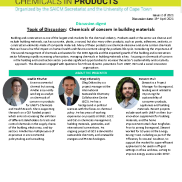
The SAICM Secretariat, in partnership with the University of Cape Town, established a community of practice on Chemicals in Products to bring representatives from different sectors together and to create a learning network around issues related to addressing Chemicals in Products (CiP). This is a summary of the discussion on Chemicals of concern in building materials, which took place on 15 April 2021.Presenters: Amélie Ritscher (UNEP), Oleg Ditkovskiy (ISC3), Stewart Muir (Bioregional)Building and construction is one of the largest end-markets
Problem statementOne of functions of the of the Strategic Approach to International Chemicals Management (SAICM) is to call for appropriate action on emerging policy issues as they arise and to forge consensus on priorities for cooperative action as identified in the paragraph 24 of the Overarching Policy Strategy (OPS). In 2015, the Fourth International Conference on Chemicals Management (ICCM-4) initiated the development of the framework for sound management of chemicals and waste beyond 2020 that is envisaged to be adopted
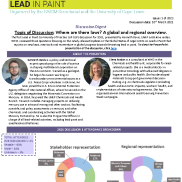
The Secretariat of the Strategic Approach to Chemicals Management (SAICM) and the University of Cape Town (UCT) have established a Community of Practice (CoP) on Lead in Paint to bring representatives from different sectors together and to create a learning network around issues related to the elimination of Lead Paint. This is a summary of the discussion on Where are there laws? A global and regional overview, which took place on 10 March 2021.Presenters: Kenneth Davis (UNEP), Elena Jardan (WHO)The
The SAICM Secretariat, in partnership with the University of Cape Town, established a community of practice on Chemicals in Products to bring representatives from different sectors together and to create a learning network around issues related to addressing Chemicals in Products (CiP). This is a summary of the discussion on Industry initiative and information sharing on chemicals in products in the supply chain, which took place on 18 February 2021.Presenter: Timo Unger (Hyundai)As engineer for Recycling Technology by training, Timo