54 resources found

Infographic

Interactive country profiles

February 2020
copied to clipboard
ContextTo address the recognized deficiencies mentioned above, it’s essential to have a ‘chemicals ecosystem (SAICM ecosystem)’ in which relevant information can be shared transparently and easy to obtain. In this ‘chemicals ecosystem’, a holistic chemicals-information-sharing hub, serving as ‘database’ and ‘scanner’ on chemicals management, should be developed to provide connection on knowledge and information from a wide variety of sources and allow stakeholders to identify their gaps on the way towards the sound management of chemicals and waste. Last but
Manuals and toolkits

Handbook on Sustainable Public Procurement - Integration Sustainability Criteria into Public Procurement Procedures for Paints and Varnishes, Cleaning Products, Heat Insulation Materials

November 2017
copied to clipboard
Public Procurement is closely interconnected with an implementation of the sustainable development goals on the practice. Given priority to environmentally friendly products and environmentally safety services, which comply with green standards and rules, is an efficient tool in solving of many economic, environmental and social challenges at different levels.This handbook contains a basic information about benefits and advantages of the sustainable public procurement for government and public authorities; a step–by–step explanations how to transform a procurement process into sustainable one
Emerging Policy Issues: Chemicals in products
Infographic

Lead infographics

by |
September 2016
copied to clipboard
What are the sources of lead in the environment? Where can you find lead? Who is at risk? How are children exposed to lead? What can you do? Did you know? - Part 1 Did you know? - Part 2 Celebrating our achievements
Emerging Policy Issues: Lead in paint
Manuals and toolkits

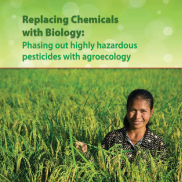
Replacing Chemicals with Biology: Phasing out highly hazardous pesticides with agroecology

September 2015
copied to clipboard
Adverse effects of highly hazardous pesticides (HHPs) on people and the environment have been a global concern for many years. In 2006, this was clearly expressed by the FAO Council when it recommended a progressive ban on HHPs. The concern crystallized at UNEP’s Fourth International Conference on Chemicals Management (ICCM4) in Nairobi in 2012, with the submission of a conference room paper supported by at least 65 countries and organizations. The proposed resolution included supporting “a progressive ban on HHPs
Emerging Policy Issues: Highly Hazardous Pesticides

Avatar