50 resources found

2212521_SAICM_GEF9771_LIP_TechGuide_cover
Manuals and toolkits

Reformulation is Entirely Possible: Summary of the Lead Paint Reformulation Technical Guidelines and How to Use this Information

This document summarizes information from the Lead Paint Reformulation Technical Guidelines, the findings and recommendations of the reformulation pilot demonstrations, and two case studies of paint manufacturers which have reformulated paint products. This summary is also intended to highlight how the information from the Guidelines can be used by different stakeholders involved in the phasing out of lead paint.The full set of technical guidelines can be accessed here.The guidelines were made possible under a global project funded by the Global

Emerging Policy Issues: Lead in paint
Topics: Policymaking
Report

A Chemicals Perspective on Designing with Sustainable Plastics: Goals, Considerations and Trade-offs

by |
December 2021
copied to clipboard
The development of plastic products does not systematically take sustainability, particularly from a chemicals perspective, into account. This report seeks to enable the creation of inherently sustainable plastic products by integrating sustainable chemistry thinking in the design process. By applying a chemicals lens during the plastic material selection process, designers and engineers can make informed decisions to incorporate sustainable plastic during the conceptualisation phase of their products. The report provides an integrated approach to sustainable plastic selection from a chemicals
Emerging Policy Issues: Chemicals in products
Topics: Life Cycle
Report

Single-Use Plastic Products (SUPP) and their alternatives: Recommendations from Life Cycle Assessments

UN Environment Programme (UNEP) defines single use plastic products as “an umbrella term for different types of products that are typically used once before being thrown away or recycled” (UNEP 2018), which includes food packaging, bottles, straws, containers, cups, cutlery and shopping bags. It has been estimated that about 100-150 million tonnes of plastics are produced for single use products and about 8 million tonnes of plastics are dumped into the oceans every year (Plastics Oceans 2019)There is a need
Emerging Policy Issues: Chemicals in products
Topics: Life Cycle
Manuals and toolkits

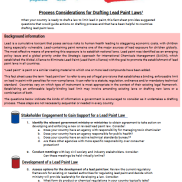
Process Considerations for Drafting Lead Paint Laws

In response to questions received by the Global Alliance to Eliminate Lead Paint on roadmaps for developing regulations on lead content in paint, the Alliance offers the following process considerations. Questions are illustrative, indicating the kinds of information a government might consider as it undertakes each component of a drafting process.
Emerging Policy Issues: Lead in paint
Topics: Policymaking
Factsheets and brochures

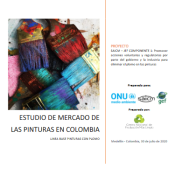
Market Analysis of the paint industry in Colombia (Draft / Spanish only)

Las pinturas se han convertido en parte esencial del estilo de vida de la sociedad moderna, el color de ellas es apetecido por sus funciones estéticas, decorativas, de protección para productos y hasta en usos como códigos de seguridad, sin embargo, su producción y uso plantea aun muchos retos en los cuales se viene trabajando tanto a nivel mundial como local.Los países más industrializados prohibieron desde hace más de 40 años el uso de pinturas con plomo. Colombia aún carece
Emerging Policy Issues: Lead in paint
Topics: Policymaking
Project document

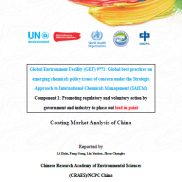
Market Analysis of the Coating Industry in China

China is a major producer of paints which supplies a considerable share of paints in the world. Key paint production hot spots were identified as Guangdong, Shanghai, Jiangsu, Hunan and Shandong provinces and cities. The cost of removing existing decorative lead paint from surfaces in homes, schools, and other buildings is significant. By comparison, the cost for eliminating the use of lead compounds in new decorative paints is low and alternatives to lead additives are available for all types of
Emerging Policy Issues: Lead in paint
Topics: Policymaking
Manuals and toolkits

Guidance to Provide Footprint Information on Sustainable Alternatives

As there is an increase in communication of concrete recommendations for better solutions and alternatives to build a better economy that protects nature, there is an increased need to back these recommendations with facts and figures about how they contribute to reduce our impact on the planet.In this sense, the life cycle team has pulled together a very simple 2-page guidance on elements to consider when backing up your recommendations with strong life-cycle based science. The 2-pager also provides links
Emerging Policy Issues: Chemicals in products
Topics: Life Cycle

Avatar